Engagement Rings Education Hub
02 April, 2026

How Subtle Shades Affect Beauty, Value & Style
When we talk about a diamond’s colour, we’re actually looking for the lack of it. The most desirable diamonds are those that appear bright, white, and colourless, allowing the maximum light to pass through and reflect sparkle.
But not all diamonds are perfectly colourless—and that’s okay! Slight tints can be invisible to the naked eye, yet make a big difference in value.
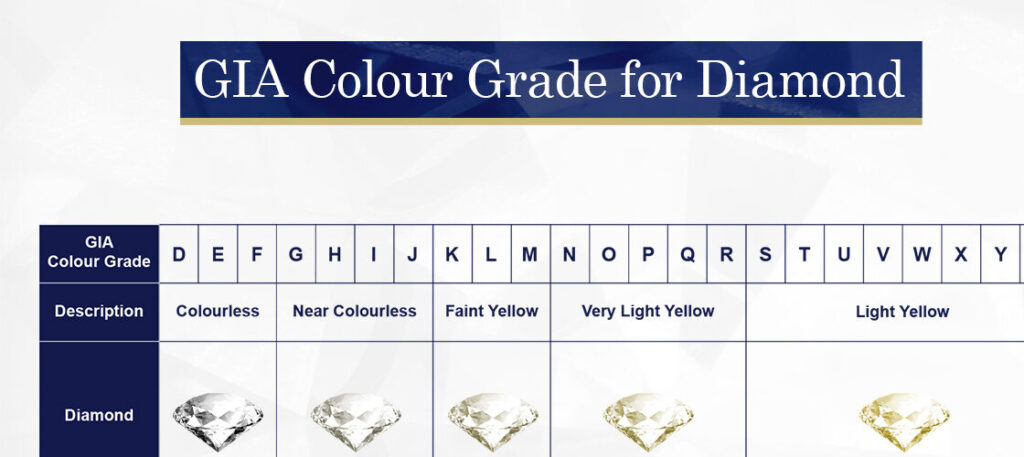
The Gemological Institute of America (GIA) grades diamond colour on a scale from D (colourless) to Z (noticeable yellow/brown tint).
| Grade Range | Description | Visible Colour | Best Use Case |
| D–F | Colourless 💠 | None | Premium rings, white metals |
| G–H | Near Colourless 💎 | Very slight | Excellent value, looks white |
| I–J | Faint Tint ✨ | Slight warmth | Warm metals, vintage styles |
| K–M | Noticeable Tint ☀️ | Yellow tone | Budget-conscious or yellow gold |
| N–Z | Obvious Colour ⚠️ | Deep tint | Not typically used in jewellery |
💡 Most people can’t distinguish a G from a D without a side-by-side comparison—making G–H diamonds great value for money.
Lab-grown diamonds follow the same grading system and can be just as colourless as mined stones—but at a lower cost. They also avoid the environmental and ethical concerns associated with some mined diamonds.
At Bespoke Diamonds, we only offer lab grown diamonds in the colour range D-F, and D-E in most carat weights below 3ct. The price difference in these is not significant for the difference in appearance.
The right metal colour can enhance or mask diamond tints. Here’s a quick guide:
| Diamond Colour | Best Metal Pairing | Why It Works |
| D–F | White gold or platinum | Enhances icy brilliance |
| G–J | Yellow or rose gold | Masks slight warmth, adds vintage charm |
| K–M | Yellow gold | Complements warm tones naturally |
🔁 A G or H colour diamond in yellow gold can look as white as a D-colour diamond in platinum—at a more accessible price point.
You might want to prioritise colour if:
Some shapes hide colour better than others:
| Diamond Shape | Colour Visibility | Tip |
| Round | Low | Reflects light well—hides tint |
| Princess/Cushion | Medium | Choose G–H for safe balance |
| Oval/Pear/Marquise | Medium-High | Slight tint may show at tips |
| Emerald/Asscher | High | Step cuts show body colour—go D–G |
Only if you’re extremely colour-sensitive or going for an ultra-luxury look. G–H often appear just as white to the eye. In lab grown diamonds, the price difference is far less significant so D-F is recommended.
Yes. Larger stones display more body colour, so colour grade becomes more important over 1.00ct.
Absolutely. Sparkle comes from cut, not colour. A well-cut K-grade diamond can still shimmer beautifully.
Tip to Mitigate: Choose G–H colour in white gold or I–J in yellow gold for a balanced look and budget.
While colour isn’t the flashiest of the 4 Cs, it plays a quiet yet vital role in a diamond’s overall beauty. Pairing the right colour with the right setting and cut ensures your diamond looks radiant—and reflects your style perfectly.
Don't miss
02 April, 2026
02 April, 2026
02 April, 2026