
Engagement Rings Education Hub
28 February, 2026
Choose our Cork or Dublin Showrooms
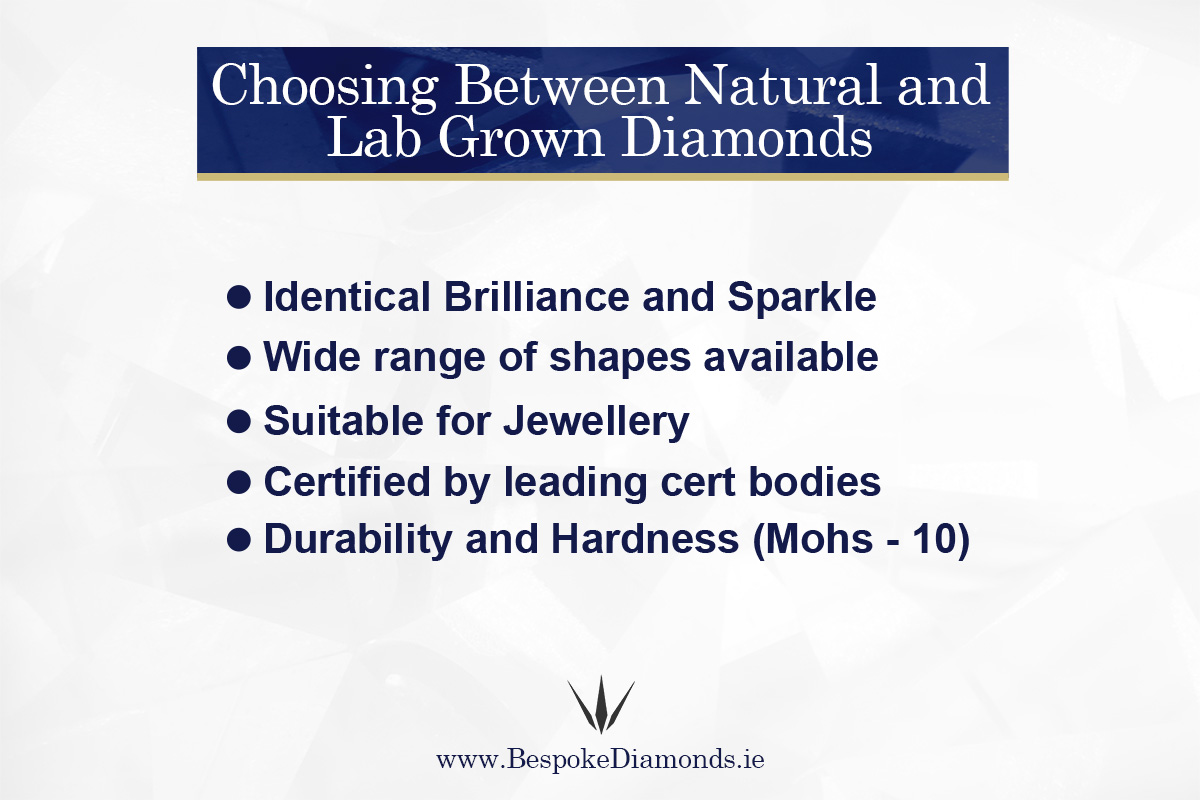
What’s the Real Difference, and Which One Is Right for You?
Whether it forms over billions of years beneath the Earth or is created in weeks in a lab, a diamond is a diamond—chemically, optically, and physically. But when it comes to choosing between lab-grown and natural diamonds, it’s about more than just sparkle.
It’s a decision that touches on ethics, origin stories, environmental impact, and personal values. Let’s break it all down so you can choose with confidence.
Lab-grown diamonds (also known as man-made, lab-created, or synthetic diamonds) are grown in advanced labs using one of two methods:
Both methods result in real diamonds that are identical to natural ones in chemical composition and crystal structure. It’s important to know that lab-grown diamonds have existed since the 1950s, but high production costs, small size, and De Beers’s tight patent control, secrecy and marketing tactics kept them confined to industrial use.
It took decades of technological refinement and strategic market repositioning before gem-quality lab diamonds emerged at scale and began to be used in engagement rings. Initially costing 20-30% less than comparable natural diamonds, the last decade has seen huge advancements in the process enabling lab diamonds to be sold for anything from 50-90% less, depending on the carat weight, shape, colour, clarity etc.
Natural diamonds are formed over 1–3 billion years deep within the Earth’s mantle, brought to the surface by volcanic eruptions.
They’re traditionally mined, cut, and polished. Many carry historical, emotional, or heirloom value because of their Earth-made origin.
| Feature | 💎 Natural Diamond | 🧪 Lab-Grown Diamond |
|---|---|---|
| Origin | Formed in Earth over billions of years | Created in labs in weeks |
| Chemical Makeup | 100% carbon | 100% carbon |
| Look & Sparkle | Identical | Identical |
| Certification | GIA, IGI, HRD | GIA, IGI, HRD |
| Environmental Impact | Mining uses more land & water | More eco-friendly, less waste |
| Price Point | Higher | Typically 60–80% less |
| Resale Value | Holds more traditional value | Resale is limited (for now) |
| Ethical Concerns | May involve conflict mining (unless traceable) | Conflict-free and transparent |
💡 Both types can be certified and insured in exactly the same way.
Q: Can you tell the difference between lab-grown and natural?
No. Not with the naked eye, nor even with a jeweller’s loupe. Only advanced lab tests can distinguish them.
Q: Do lab-grown diamonds sparkle the same?
Yes. Sparkle is all about cut quality, not origin. A well-cut lab diamond will sparkle just like a top-quality natural one.
Q: Are lab-grown diamonds fake?
Absolutely not. They are real diamonds—just made above ground.
Q: Are natural diamonds ethically safe?
Only if sourced responsibly. Look for stones with traceable origin, Kimberley Process certification, or those from ethical Irish or EU jewellers.
| Your Priority | Best Choice |
|---|---|
| 💶 Better value for budget | Lab-grown |
| 💍 Want to propose with tradition | Natural |
| 🌍 Eco-consciousness | Lab-grown |
| 🔁 Future resale or inheritance | Natural |
| 💎 Desire for rarity | Natural |
| ✨ Big look without high cost | Lab-grown |
No matter which you choose, always ask for certification from GIA, IGI or HRD. It guarantees quality, grading accuracy, and peace of mind.
Also, be sure your jeweller discloses the diamond’s origin—lab-grown diamonds must be labelled clearly by law in Ireland and the EU.
Both natural and lab-grown diamonds offer real beauty and deep meaning—just with different origin stories.
Whether you’re drawn to the eternal elegance of Earth’s creation or the ethical innovation of modern technology, there’s no wrong choice. What matters most is that your diamond reflects your values, your love, and your story.
Don't miss
28 February, 2026
28 February, 2026
28 February, 2026