
Engagement Rings Education Hub
16 January, 2026
Choose our Cork or Dublin Showrooms

Diamond fluorescence refers to the soft glow a diamond emits under UV (ultraviolet) light, such as a blacklight. This glow is usually blue, but on rare occasions can appear white, yellow, or even green.
But here’s the key point: Fluorescence has no impact on a diamond’s structure or durability, yet it can affect how it looks—especially in certain lighting.
In normal lighting conditions (sunlight, indoor lights), most people won’t notice any fluorescence at all. But under UV light (like in some clubs, jewellery shops, or direct sunlight), the effect may be slightly visible.
Depending on the intensity, it can either enhance or detract from a diamond’s appearance.
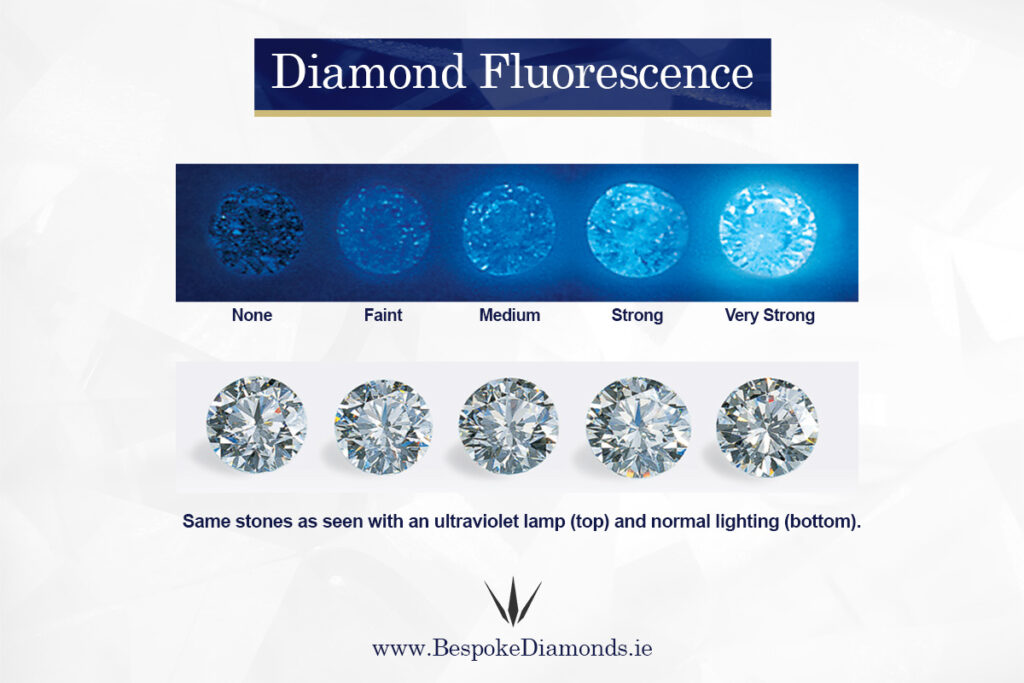
| Grade | Description | Visible Effect in UV? |
|---|---|---|
| None | No fluorescence | No visible glow |
| Faint | Very slight glow | Barely noticeable |
| Medium | Moderate glow | May appear slightly milky in rare cases |
| Strong | Noticeable glow | Can improve colour or cause haziness |
| Very Strong | Intense glow | Often visible; may appear oily or cloudy |
💎 Over 25% of diamonds show some level of fluorescence—so it’s more common than you think.
In many cases, fluorescence can actually be a value-adding or cost-saving feature:
✅ Yes, consider it if:
❌ Be cautious if:
Q: Does fluorescence mean the diamond is fake?
Not at all. Many real, certified diamonds have natural fluorescence. It’s a common trait in Earth-formed diamonds.
Q: Can fluorescence affect a diamond’s sparkle?
Only if it’s very strong and causes haziness. Otherwise, cut quality determines sparkle—not fluorescence.
Q: Does lab-grown fluorescence differ from natural?
Both natural and lab-grown diamonds can show fluorescence. However, lab-grown stones are often screened for strong reactions and graded accordingly.
Mitigation Tip: Ask your jeweller to show the diamond under UV light before you buy, and stick to faint or medium fluorescence for safety.
Fluorescence is a fascinating feature that sits beyond the 4 Cs, often overlooked by first-time buyers. But with a bit of insight, it can be your secret to:
As long as you view the diamond in natural and UV light, fluorescence can be your hidden gem.
Don't miss
16 January, 2026
16 January, 2026

16 January, 2026